How Signia, Phonak, Widex & Oticon Actually Differ
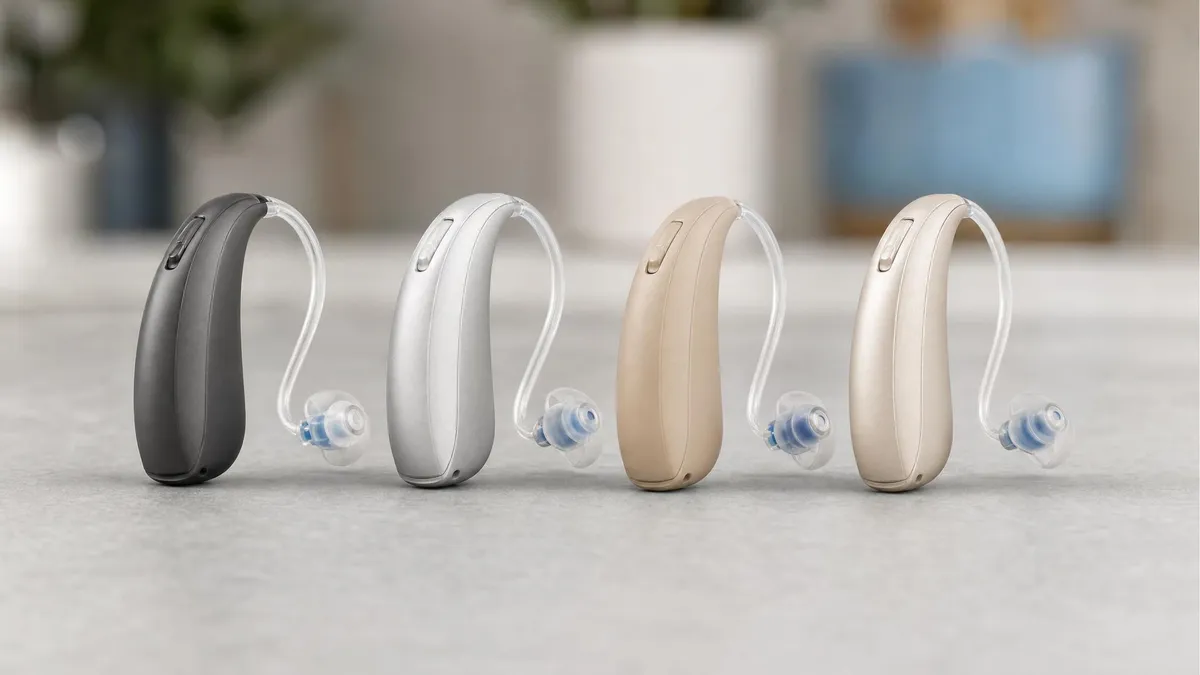
Ask which of Signia, Phonak, Widex and Oticon is “best” and you get marketing. Ask how they actually differ, and you get something more useful: a small number of parent companies, and a few genuinely different bets about how a hearing aid should turn sound into hearing. This is the engineering companion to our buyer’s guide, Phonak vs Signia vs Oticon vs Widex: which is best for you — that one helps you choose; this one explains why they are not the same.
First, who actually owns them
The hearing-aid world looks crowded but is not. Five groups make roughly 95% of the world’s hearing aids, and our four brands sit inside just three of them:
| Brand | Parent group | Also owns |
|---|---|---|
| Phonak | Sonova (Switzerland) | Unitron |
| Oticon | Demant (Denmark, formerly William Demant) | Bernafon, Sonic |
| Signia | WS Audiology | Widex |
| Widex | WS Audiology | Signia |
The surprise for most people is the last two rows: Signia and Widex are siblings. WS Audiology was created when Sivantos — the former Siemens hearing-aid business, later rebranded Signia — merged with Widex in 2019. Yet the two are kept deliberately distinct, because they represent opposite sound philosophies. That is the whole point of what follows: ownership tells you who banks the profit; processing philosophy tells you what the device will actually sound like.
Four different bets about sound
Every hearing aid faces the same hard problem — pulling the voice you want out of the noise you don’t — and each brand has made a different, long-standing bet about how to solve it.
Oticon — preserve the whole scene, let the brain choose
Oticon’s flagship idea is “open sound” / BrainHearing. Where older designs narrow aggressively onto one talker, Oticon argues the brain is the real sound processor and works best with access to the full scene — so it tries to preserve multiple speakers and the surrounding soundscape rather than delete them. Its modern platforms run an onboard deep neural network (DNN) trained on millions of real sound scenes to do this cleanly, and the latest generation adds sensors that infer what you’re trying to listen to (your movement and head orientation). The bet: less listening effort, more natural awareness.
Phonak — maximise speech-in-noise, automatically
Phonak’s philosophy is decisive and automatic. Its AutoSense operating system continuously classifies the environment and blends the right settings without you touching anything, and it leans into strong directionality and noise reduction to lift speech out of noise. Phonak also owns the Roger remote-microphone ecosystem for hearing at distance or in real din. Its newest platform goes further, adding a dedicated AI chip running a deep neural network to separate speech from noise in real time. The bet: measurably better speech-in-noise, handled for you.
Widex — the most natural, lowest-latency sound
Widex bets on naturalness above all. Its PureSound processing uses an ultra-low-latency signal path (“ZeroDelay”) to avoid the faint hollow or “comb-filter” artefacts that creep in when a device processes sound a fraction too slowly — the kind of thing musicians and particular listeners notice immediately. Layered on top is machine-learning personalisation that lets you teach the aids your preferences. The bet: the least “processed”-sounding device, with a particular edge for music and your own voice.
Signia — split the signal, protect the conversation
Signia’s signature is parallel / split processing — handling speech and background separately so it can lift one without smearing the other. It pairs this with RealTime Conversation Enhancement for group settings (several talkers at a table) and Own Voice Processing (OVP), tuned so your own voice sounds natural rather than boomy — a common early complaint. Signia also invests heavily in design (the slim Styletto, the tiny Silk). The bet: group conversations, own-voice comfort, and looks.
The one-line comparison
| Brand | Parent | Signature approach | Strongest bet |
|---|---|---|---|
| Oticon | Demant | Open sound + onboard DNN | Low listening effort, natural awareness |
| Phonak | Sonova | AutoSense + dedicated AI chip | Automatic speech-in-noise |
| Widex | WS Audiology | PureSound / ZeroDelay | Natural sound, music, own voice |
| Signia | WS Audiology | Split processing + OVP | Group talk, own-voice comfort, design |
Why the philosophy is real — but not decisive
These differences are not spin; they reflect years of divergent engineering, and you can hear them in a careful comparison. But two cautions keep it honest:
- Every brand is converging on AI. On-device neural networks, better directionality and rechargeability are now common ground. Each still applies them through its own philosophy, but the gaps are narrower than the marketing suggests.
- Fit beats badge. For most people, the audiogram, the physical fit in your ear, and a real-world trial matter more than which philosophy you pick. A brilliant platform fitted poorly loses to an ordinary one fitted well.
There is also a smart-money angle worth knowing: last year’s flagship from any of these brands usually keeps most of the current model’s real-world performance at a lower price. We cover that, and how to run a proper trial, in the buyer’s guide and the real price ranges.
How to actually use this
Read the philosophies as hypotheses to test, not verdicts. If your struggle is groups and your own voice, Signia’s approach is worth trialling; if it’s raw speech-in-noise, Phonak’s; if you’re sound-sensitive or a music lover, Widex’s; if you want effortless awareness, Oticon’s. Then prove it on your own ears.
Because we are brand-independent, Let’s Hear can trial devices from different philosophies against your audiogram at any of our clinics — see the hearing-aids we fit, including Phonak, Signia, Oticon and Widex. Start with a free hearing test or the 5-minute online check, or call +91 70222 36768.
Sources
- Sonova — Swiss group owning Phonak and Unitron (company profile).
- Demant (formerly William Demant) — Danish group owning Oticon, Bernafon and Sonic (company profile).
- WS Audiology — owns Widex and Signia; formed by the Sivantos–Widex merger (announced 2019); Sivantos is the former Siemens hearing-aid business (HearingReview, industry reporting).
- Industry structure — a small number of groups (Sonova, Demant, WS Audiology, GN, Starkey) produce roughly 95% of hearing aids.
- Brand sound-processing approaches — Oticon “open sound”/BrainHearing with onboard DNN; Phonak AutoSense and dedicated real-time AI noise processing; Widex PureSound/ZeroDelay low-latency; Signia split processing, RealTime Conversation Enhancement and Own Voice Processing (manufacturer platform documentation).