RIC vs BTE vs CIC vs Invisible: Which Hearing Aid Style Suits You?
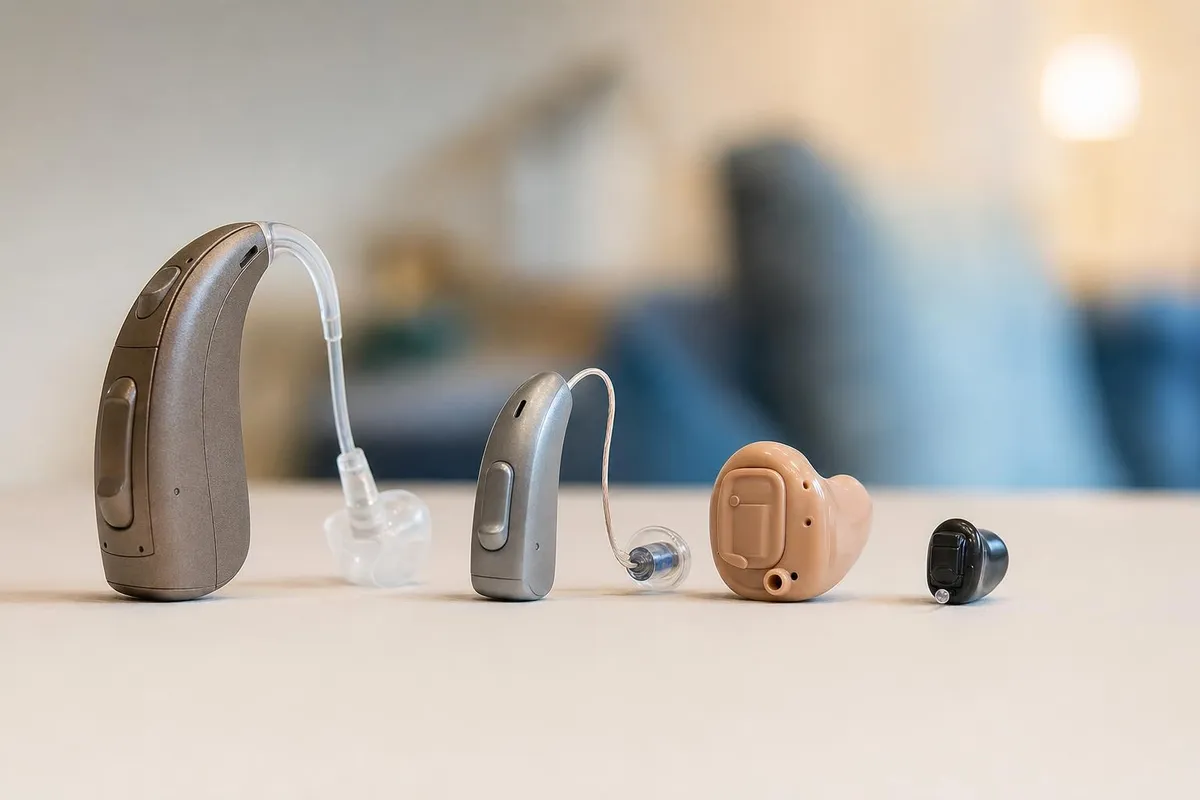
Hearing aids come in four broad styles — RIC (receiver-in-canal), BTE (behind-the-ear), custom in-the-ear (ITE/ITC/CIC), and invisible (IIC) — and the right one depends on your degree of loss, ear shape, dexterity and how much discretion matters to you. Here are the honest trade-offs, followed by how the choice actually gets made in the clinic.
The four styles at a glance
| RIC | BTE | Custom (ITE/ITC/CIC) | Invisible (IIC) | |
|---|---|---|---|---|
| Loss it can fit | Mild → severe | Mild → profound | Mild → mod-severe | Mild → moderate |
| Discretion | High (slim wire) | Lowest | Medium → high | Total |
| Rechargeable options | Standard | Common | Larger sizes | Rare (Silk IX is the exception) |
| Bluetooth streaming | Standard | Common | Larger sizes | Usually no |
| Easy to handle | Good | Best | Varies with size | Hardest |
| Wax/moisture exposure | Medium | Lowest | High | Highest |
RIC — the modern default
A small case behind the ear with a thin wire to a speaker in the canal.
- Strengths: fits mild through severe loss; the style with the most technology choice (nearly every 2026 flagship is a RIC); rechargeable and Bluetooth almost standard; comfortable, open sound.
- Trade-offs: visible up close (though slim — the Signia Styletto IX makes a design feature of it); the in-canal speaker needs wax-guard care.
- Typical models we fit: Phonak Audéo Sphere Infinio, Oticon Intent, ReSound Vivia, Widex SmartRIC.
BTE — maximum power and robustness
All electronics behind the ear, sound delivered via tube and earmold.
- Strengths: the most amplification — the only choice for severe-to- profound loss (Phonak Naída Lumity, Oticon Xceed, ReSound Enzo Q); rugged; easy to handle with limited finger dexterity; telecoil options.
- Trade-offs: the most visible style; the earmold gives a more closed feeling.
- Best for: severe/profound loss, children (retubing is cheap as ears grow), and anyone who prioritises reliability over discretion.
Custom in-the-ear — ITE, ITC, CIC
Molded to your ear, sitting fully in the concha or canal.
- Strengths: nothing behind the ear (glasses and masks stay easy); custom fit suits difficult canal shapes (Starkey Picasso is famous for this); larger ITE versions offer rechargeability and streaming (Signia Insio, Phonak Virto).
- Trade-offs: smaller versions trade away battery life, power and features; more exposed to wax and moisture, so daily brushing matters.
- Best for: mild-to-moderately-severe loss with a strong preference for an all-in-ear device.
Invisible — IIC and instant-fit deep-canal
Sits deep in the canal, essentially undetectable.
- Strengths: cosmetically invisible; natural microphone position uses the ear’s own acoustics. The Signia Silk Charge&Go IX is even instant-fit — soft sleeves instead of a custom mold, and rechargeable.
- Trade-offs: the tightest limits — mild-to-moderate loss only, tiny (or no) controls, usually no Bluetooth, smallest batteries.
- Best for: discretion-first buyers whose audiogram allows it.
A special case: hearing in only one ear (single-sided deafness) is its own category — a CROS transmitter (like the Phonak CROS Infinio) worn on the deaf side sends sound to an aid on the hearing ear. If this is you, ask about CROS specifically.
How the choice actually gets made in the clinic
When our audiologists recommend a style, four factors do most of the deciding:
- The audiogram. Degree and shape of loss rule styles in or out before preference enters. Severe loss needs BTE/power-RIC hardware; steep high-frequency losses often suit open RIC fits that leave low pitches natural.
- Your ear itself. Canal width and shape, wax production, past surgeries. Heavy wax producers do better with styles that keep electronics out of the canal or are easy to clean.
- Your hands and eyes. If picking a coin off a table is hard, a tiny CIC with a rice-grain battery will live in a drawer. Rechargeable RIC/BTE wins.
- Your phone and TV habits. Heavy callers and streamers should stay in styles with full Bluetooth — usually RIC, BTE, or larger customs.
Three real-life sketches: a site engineer in noise all day usually lands on a robust, waterproof RIC/BTE at a higher tech tier; a retired teacher who mostly watches TV and meets family does beautifully with a mid-tier rechargeable RIC; a self-conscious first-timer with mild loss is often happiest starting with an instant-fit invisible — knowing they can step up later.
How to choose in practice
Start with the audiogram (it rules styles in or out), then be honest about your hands, your phone habits and how you feel about visibility. Then trial it — all styles come with our 7-day trial, and prices for every style are in the catalog and our price guide. A free hearing test at any of our 8 clinics settles the question with evidence rather than guesswork.