Bangalore's Noise Problem: Traffic, Festivals and Your Hearing
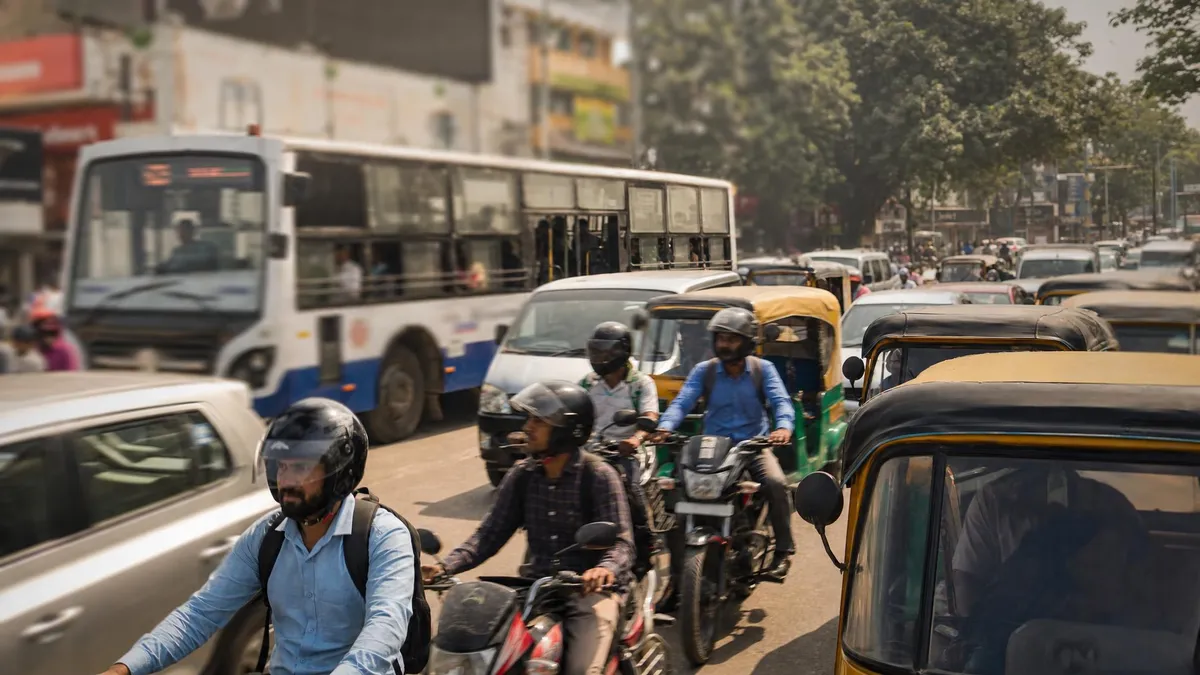
Bengaluru is a loud city, and unlike air pollution you cannot see it. This is a data-led look at how loud — using measured decibel readings, not impressions — what the law actually allows, and what sustained exposure does to the ears. Where a figure comes from monitoring or research, it carries a citation; where the picture is uncertain, we say so.
First, how to read a decibel
The decibel (dB) scale is logarithmic, which is why the numbers below matter more than they look:
- Every +3 dB roughly doubles the sound energy hitting your ear.
- Every +10 dB is heard as about twice as loud.
So a junction at 80 dB against a 65 dB limit is not “23% over” — it is carrying many times the sound energy the standard was written to allow.
What the law allows — and the city breaks
India’s Central Pollution Control Board (CPCB) sets ambient-noise limits by zone, day and night. The Karnataka State Pollution Control Board (KSPCB) monitors them across continuous stations in Bengaluru.
| Zone | Day limit | Night limit |
|---|---|---|
| Silence zone (near hospitals, schools, courts) | 50 dB | 40 dB |
| Residential | 55 dB | 45 dB |
| Commercial | 65 dB | 55 dB |
| Industrial | 75 dB | 70 dB |
These are not aspirational — they are the standard. In practice Bengaluru’s residential and silence zones routinely exceed them. Monitoring near the RVCE campus on Mysore Road, for instance, recorded noise 71% over the permissible night limit and 39.8% over the day limit.
Traffic: the everyday exposure
Traffic is the baseline most residents live inside. A study measuring vehicular noise at selected Bengaluru junctions (TENMA sound-level meter, readings taken at road level) found every junction well above the commercial-zone limit:
| Junction | Peak-hour (dB) |
|---|---|
| H. Siddaiah & Double Road | 80.6 |
| Langford & KH Road (St Joseph’s) | 79.6 |
| Victoria Statue, Cubbon Park | 79.4 |
| Thimmaiah & Hosur Road | 78.4 |
| Langford & Hosur Road | 78.3 |
| MG Road & Brigade Road | 77.7 |
| Richmond Circle | 77.0 (up to 82.3 off-peak) |
| Lalbagh | 76.7 |
| ITC Gardenia | 76.1 |
| Kasturba & Vittal Mallya Road | 76.0 |
Readings cluster around 76–82 dB(A) — 15 to 25 dB over the 55 dB residential limit. The pressure has a clear source: the Central Silk Board junction carries roughly 10,000 passenger-car-units per hour, among the worst traffic loads in the city, and honking piles impulsive peaks on top of the continuous roar. (Bengaluru’s traffic police have run “No Honking” campaigns precisely because horn noise is both avoidable and damaging.)
Festivals: the peaks that do sudden damage
Where traffic is a chronic, grinding exposure, festival firecrackers deliver the sudden, high-intensity peaks that can injure hearing in an instant. The legal ceiling for firecrackers outside silence zones is 125 dB — and bursting is banned outright in silence zones near hospitals and schools.
During Diwali, Bengaluru’s city-wide average noise has been measured rising to about 74.6 dB (from ~72.7 dB before), with sharp local hotspots:
| Area (one year’s Diwali monitoring) | Noise (dB) |
|---|---|
| Sarjapur | 84.6 |
| Anekal | 80.8 |
| Yelahanka | 80.5 |
| Mahadevapura | 72.8 |
| Indiranagar | 72.1 |
| Peenya | 69.8 |
| Jayanagar | 69.2 |
The danger is not the citywide average — it is close range. A firecracker going off a few metres away can exceed 120 dB at the ear, a level that causes immediate, permanent damage. Children, whose ear canals are smaller and who often stand closest, are the most exposed.
What noise actually does to your ears
Loud sound damages the hair cells of the inner ear — the sensory cells that turn sound into nerve signals. In humans they do not grow back, which is why noise-induced hearing loss is permanent but preventable. Two rules govern the risk:
- It is dose-dependent. Both intensity and duration matter. The occupational safety benchmark is 85 dB(A) for an 8-hour day; every few decibels above that shortens the safe exposure time sharply.
- It is painless and gradual. The classic early sign is difficulty understanding speech in noise — losing the high frequencies that carry consonants — long before sounds become hard to hear.
A single crossing of a loud junction will not deafen you. But a daily two-hour commute on an open two-wheeler, a traffic constable’s shift, or a roadside vendor’s working day is exactly the chronic, cumulative exposure that adds up over years. For the mechanism and the occupational evidence in detail, see our reference on noise-induced hearing loss in Indian industry.
Who should get checked — and what you can do
If your day is spent beside moving traffic — police, auto and cab drivers, delivery riders, vendors, long-distance commuters — periodic hearing checks are worth it even if your hearing feels fine, because the damage is silent until it is advanced.
Practical steps that genuinely help:
- Keep distance from firecrackers, and give children ear muffs or plugs at Diwali. Distance is the single biggest protector — sound energy falls steeply with every metre.
- Cut avoidable noise: don’t add to horn noise; keep two-wheeler and helmet wind noise down; use closed windows in a car on bad stretches.
- Give your ears quiet recovery time after loud exposure.
- Get a baseline test. Knowing where you stand today is what lets you catch a shift early, while protection can still preserve what remains.
You can start with our free 5-minute online hearing check, and if it flags anything — or if you simply spend your days in traffic — book a free hearing test at any Let’s Hear clinic, including our Bangalore clinics. To understand what an audiogram means once you have one, read understanding your hearing loss. Call +91 70222 36768 to book.
Sources
- CPCB Ambient Air Quality Standards in respect of Noise — zone-wise day/night limits (silence 50/40, residential 55/45, commercial 65/55, industrial 75/70 dB).
- KSPCB continuous noise monitoring, Bengaluru — network of stations across silence, residential, commercial and industrial zones; residential/silence zones recorded exceeding limits (incl. RVCE Mysore Road +71% night, +39.8% day).
- “Noise Pollution from Vehicular Traffic from Selected Junctions in Bengaluru” — measured peak-hour levels of ~76–82.3 dB(A) at major junctions (TENMA sound-level meter).
- Diwali ambient-noise monitoring, Bengaluru — city average ~74.6 dB, with Sarjapur ~84.6 dB and Anekal ~80.8 dB (Deccan Herald reporting on KSPCB data).
- Firecracker noise limit 125 dB outside silence zones; bursting banned in silence zones (CPCB / Supreme Court directions).
- Occupational exposure benchmark 85 dB(A) for 8 hours (NIOSH / WHO); hair-cell damage is permanent and dose-dependent.