Noise-Induced Hearing Loss in Indian Industry: What the Evidence Shows
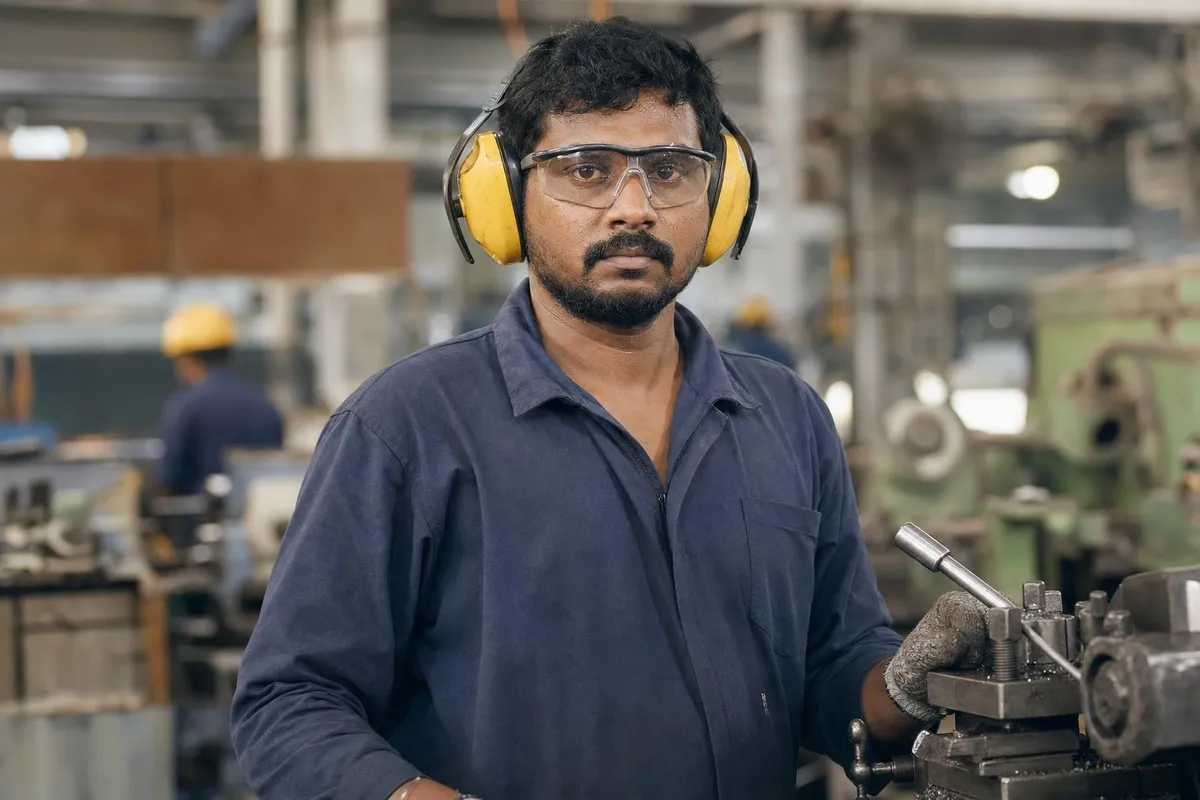
Noise-induced hearing loss (NIHL) is permanent, untreatable by medicine or surgery — and almost entirely preventable. In Indian industry it is also strikingly common: a 2022 systematic review and meta-analysis of 22 Indian studies found a pooled prevalence of 0.49 (95% CI 0.22–0.76) among the exposed workers studied, meaning roughly half of workers across the sampled industries showed measurable noise-induced hearing loss.
This page is a sourced reference for safety officers, HR teams, factory managers and occupational-health practitioners. Every figure below carries a citation; where evidence is uncertain or contested, we say so.
The legal position in India
| Item | Position |
|---|---|
| Permissible exposure | 90 dB(A) for 8 hours continuous exposure, per DGFASLI recommendation |
| Legal status of NIHL | Recognised as a notifiable disease under the Factories Act |
| Noise-control provisions | The Factories Act does not stipulate specific noise-control provisions |
| Where limits are exceeded | An administered, effective hearing conservation programme is required — including pre-employment and periodic auditory surveys of exposed workers, and rehabilitation of affected workers |
The gap between the standard and practice is the central problem: research notes that industries including textile (woollen and jute mills), woodworking, marble, ceramic and similar sectors routinely exceed the 90 dB(A) limit, and that use of hearing protection among studied workers was minimal.
What the Indian evidence shows
The strongest single source is Basu, Aggarwal, Dushyant & Garg (2022), a systematic review and meta-analysis published in the Indian Journal of Community Medicine:
- 22 studies pooled, mean effective sample size 107.1 workers per study
- Pooled NIHL prevalence: 0.49 (95% CI 0.22–0.76)
- Pooled hearing loss (any category): 0.53 (95% CI 0.28–0.78)
- Industries covered: stone cutting, ginning, plywood, heavy metal, farming, mining, explosive manufacturing, sugarcane processing, steel, handicraft, plastic weaving
- The review reported minimal use of protective equipment across studies
A note on reading these numbers honestly: the confidence interval is wide (0.22–0.76). That reflects genuine variation between industries, noise levels and audiometric methods — not a precise national rate. The defensible reading is that NIHL affects a substantial minority to majority of noise-exposed Indian workers, and that the burden is large enough to justify systematic screening in any high-noise workplace.
For global context, the WHO’s World Report on Hearing (2021) estimates 1.5 billion people live with some degree of hearing loss, projected to reach nearly 2.5 billion by 2050.
Why noise damage is different from other hearing loss
Noise destroys the hair cells of the cochlea — the sensory cells that convert sound into nerve signals. In humans these do not regenerate. The practical consequences shape everything about workplace policy:
- It is permanent. No hearing aid, medicine or surgery restores the lost cells. Hearing aids compensate; they do not repair.
- It is painless and gradual, so workers rarely notice it happening. The classic pattern is a notch at 4 kHz — right in the range that carries consonants — so speech becomes hard to understand long before it becomes hard to hear.
- It is dose-dependent. Both intensity and duration matter, which is why the standard is expressed as a level for a time period.
- It is preventable — the only one of these four that offers any leverage. Everything gained must be gained before the damage occurs.
Which South Indian sectors carry the most risk
Our own corporate work concentrates in western Tamil Nadu and coastal Karnataka, where the industrial mix creates predictable exposure:
- Textile and knitwear — Tirupur’s mills and the wider Coimbatore belt. Continuous machine noise across long shifts is the classic NIHL profile.
- Engineering, foundries and heavy metal work — impact noise on top of a high continuous baseline.
- Stone cutting and construction — among the highest-exposure trades in the meta-analysis.
- Transport and logistics depots — often overlooked because noise is intermittent, but cumulative exposure adds up.
- Hospitality and events — amplified music venues frequently exceed occupational limits, with staff exposed for full shifts.
What an effective programme actually contains
A hearing conservation programme is not a once-a-year formality. The components that make it work:
1. Measure the environment first. You cannot manage exposure you have not quantified. Noise mapping identifies which zones exceed 90 dB(A) and for how long — this determines who needs surveillance.
2. Baseline audiometry for every exposed worker. A pre-employment or programme-start audiogram is the reference against which all future tests are compared. Without it, later loss cannot be attributed or acted on.
3. Periodic re-testing. Annual audiometry for exposed workers detects shifts — early change against baseline — while protection can still preserve what remains. Detecting a shift is the entire point; detecting established loss is already too late.
4. Protection matched to real zones, and actually worn. The best theoretical protector left in a locker protects nobody. Fit, comfort and communication needs determine real-world compliance far more than the attenuation rating.
5. Education that explains the mechanism. Workers who understand that hair cells do not grow back behave differently from workers told only to “wear your plugs.”
6. A referral pathway. Any worker showing a significant shift needs a full clinical assessment, not just a note in a file.
Reporting that survives an audit
Whatever provider runs your programme, the output should give your safety team: individual audiograms with baseline comparison, a register of workers showing threshold shifts, year-on-year trend data by zone or department, and clear flags for those needing clinical follow-up. Filing that is the difference between a compliance record and a genuine prevention programme.
Working with Let’s Hear
Our corporate and industrial hearing programmes run on-site across South India — baseline and periodic audiometry scheduled around shifts, plain-language reporting for EHS teams, hearing-protection guidance, and a referral pathway into our 8 clinics for any worker who needs full assessment. Our Coimbatore clinic serves the textile belt including Tirupur directly.
To scope a programme, we need three things: headcount of noise-exposed workers, shift patterns, and whether you want on-site or in-clinic testing. Email letshearinfo@gmail.com or call +91 70222 36768 and ask for corporate programmes.
Individual workers who suspect their hearing has changed can start with our free 5-minute online hearing check, or book a free clinic test — and should read our guide to understanding hearing loss for what the results mean.
Sources
- Basu S, Aggarwal A, Dushyant K, Garg S. Occupational Noise Induced Hearing Loss in India: A Systematic Review and Meta-Analysis. Indian Journal of Community Medicine. 2022;47(2):166–171. doi:10.4103/ijcm.ijcm_1267_21
- Directorate General Factory Advice Service and Labour Institutes (DGFASLI) — recommended permissible exposure limit of 90 dB(A) for 8 hours.
- Factories Act — noise-induced hearing loss listed as a notifiable disease.
- World Health Organization. World Report on Hearing. 2021 — global prevalence and 2050 projections.